
Survey: AI hallucinated travel destinations for 1 in 6 users
Greetwell reports 1 in 6 travelers using AI received false travel recommendations, with 55% encountering inaccurate

Press Release Disclaimer: This is a press release distributed through the XPR Media network. It has not been independently verified by our newsroom.


Wasana Kunpol // Shutterstock
Survey: AI hallucinated travel destinations for 1 in 6 users
Oftentimes, to plan a trip, you Google where you want to go. Now it’s asking AI chatbots. Yet in a new study by travel concierge company Greetwell, 1 in 6 AI-using travelers were recommended a place, tour or activity that wasn’t real. More than half of AI users (55%) hit at least one bad recommendation of any kind.
AI is being adopted throughout all parts of life, and can plan trips in seconds with less effort on the searcher. Deloitte’s 2026 travel research shows that AI use for travel rose from 15% to 25% in a year.
So why is it sending travelers to places that don’t exist?
AI Is Great For Planning, Not So Much for Booking
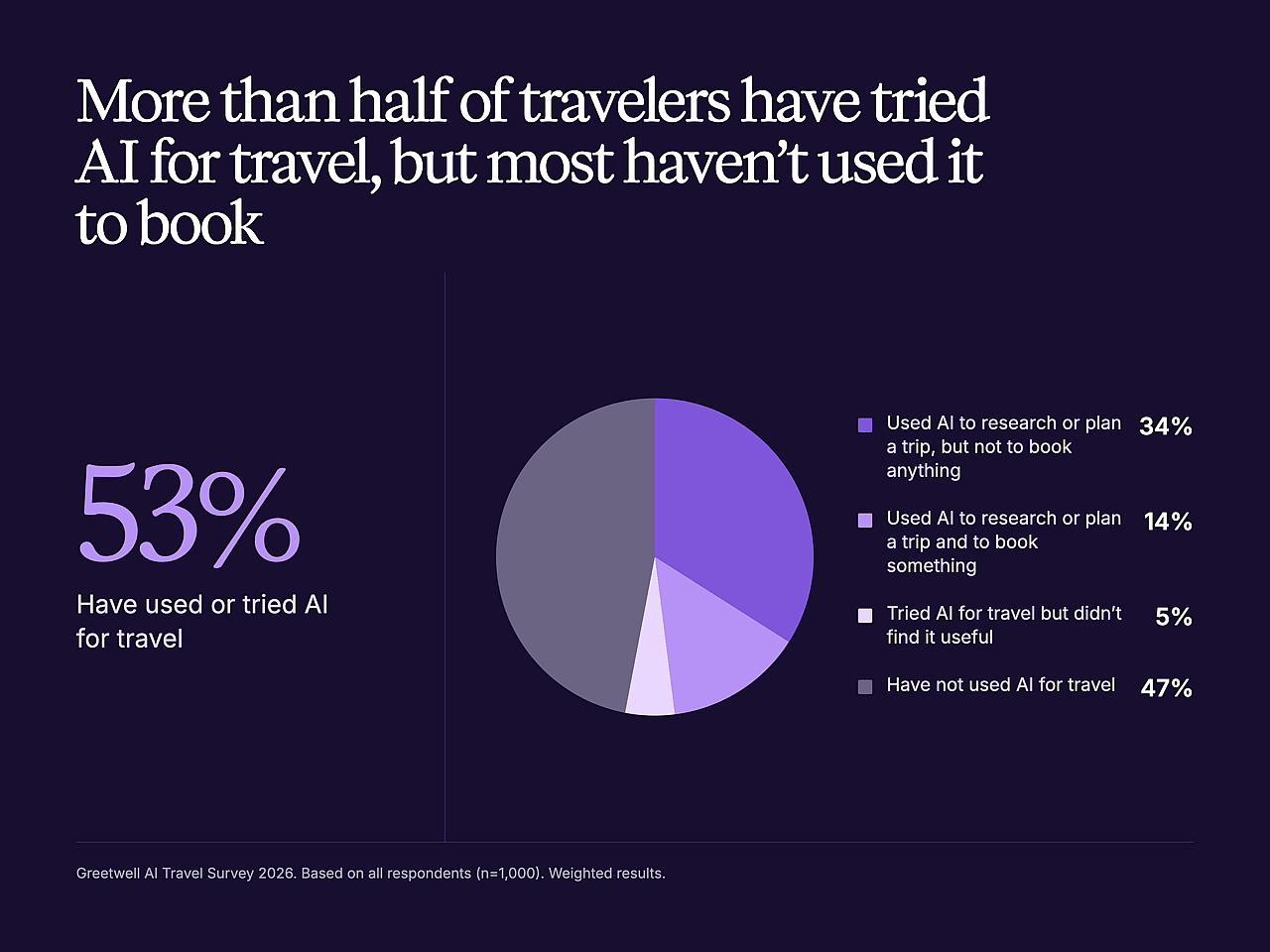
The survey says that a little over half (53%) of respondents have used AI or tried AI for travel. But that trust vanishes when it comes to making actual reservations.
Greetwell
A little over a third (34%) used AI to research or plan a trip, but not to book anything. Meanwhile, 14% used AI to research and book a trip, while 5% tried AI but didn’t find it useful.
Adoption is high, but the real question is how it performs.
More Than Half Experienced an AI Inaccuracy
Greetwell
Among the travelers who used AI for trips, more than half encountered at least one bad recommendation. Broken down, here are the failure types (respondents could pick more than one):
- Incorrect prices, hours, or other details (27%)
- Fully booked or unavailable (21%)
- Simply wrong for what they asked (17%)
- A place, tour, or activity that didn’t exist (16%)
- A business that was permanently closed (10%)
A wrong address is one thing. Planning a vacation around an event that doesn’t exist is wasted time that people cannot get back.
Travelers Who Hit Problems Report Declining Trust
Despite the inaccuracy, a little over a third (34%) said their trust in AI increased over the past year, versus 14% who say their trust declined.
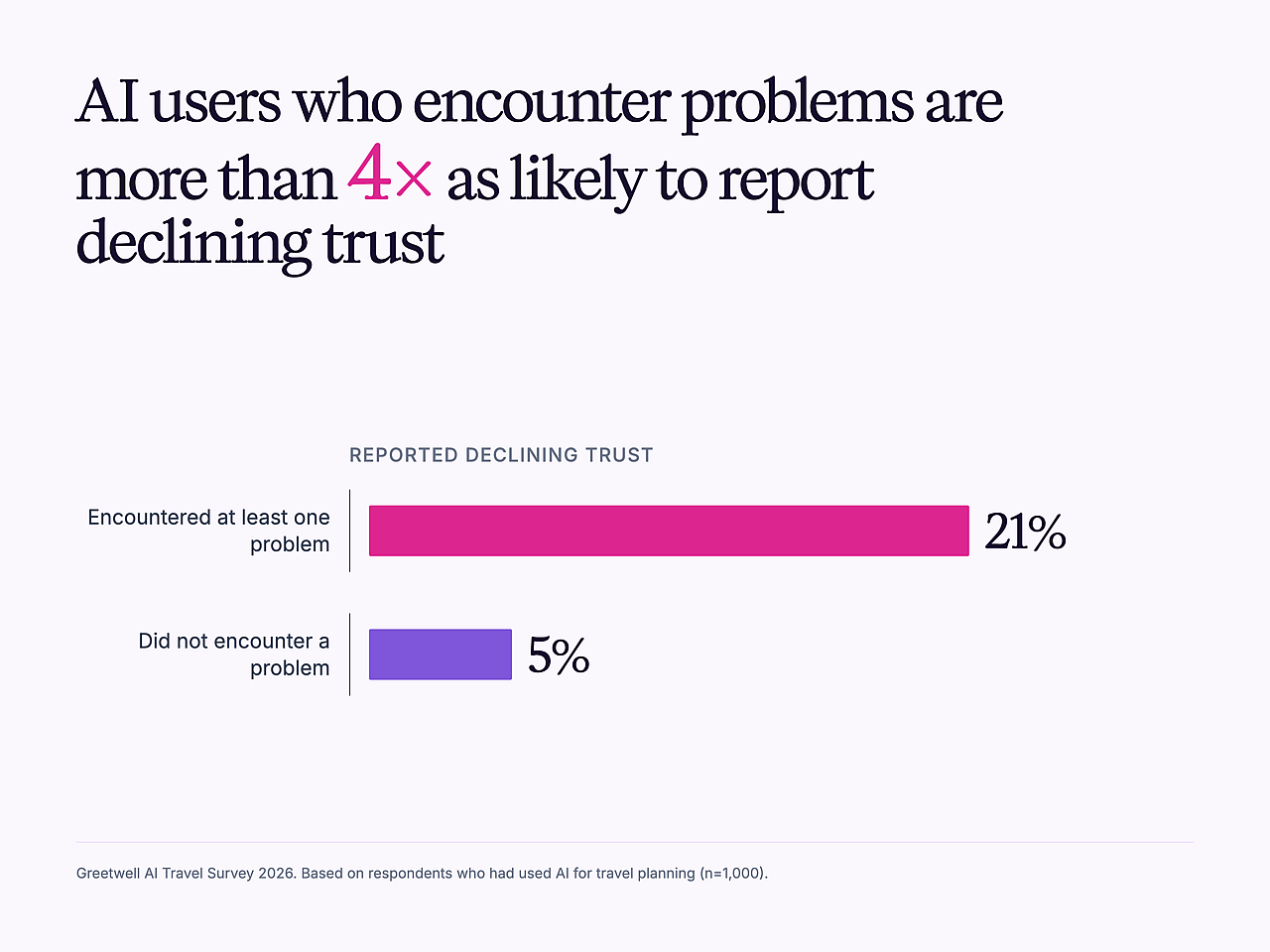
Yet ask the same question to the travelers who’ve experienced a problem with AI recommendations, the answer changes. Perhaps the rose-colored glasses are slipping, but among those who encountered at least one problem, 21% said their trust declined versus 5% of those who didn’t.
The survey is clear that it cannot establish a causal relationship between the two, but it does beg the question of how far travelers will let AI go before they vet it.
The Trust Stops at Booking
The majority of respondents don’t trust it to book for them unsupervised, from flights to dinner reservations:
- Flights (68%)
- Rental Cars (65%)
- Hotels (64%)
- Local tour or activity (63%)
- Restaurant reservations (54%)
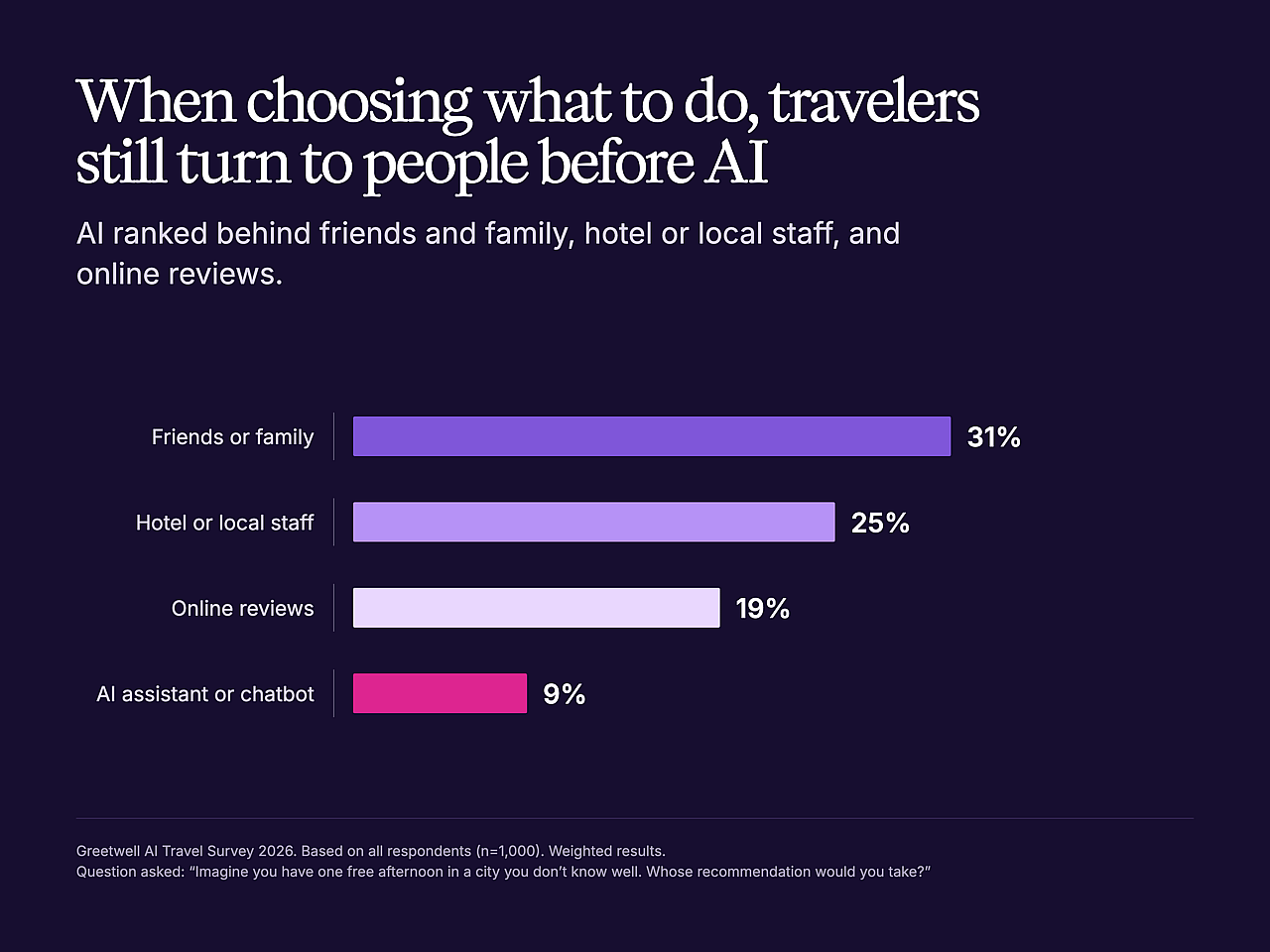
Additionally, when given the scenario of one free afternoon in an unknown city, respondents would rather take the recommendations of friends or family (31%) than AI (9%). And when asked if their activities were to be cancelled because of the weather, nearly two thirds (65%) said they want a real person they can call or message about a rebooking or a refund.
Greetwell
The human touch is still wanted. AI has many benefits when it comes to travel planning, which is still fragmented across traditional search. Yet when it comes to reliable recommendations, humans are still the better source of information.
Methodology
Greetwell commissioned an online survey in August 2026 of 1,000 U.S. adults. These adults took at least one overnight leisure trip in the past 12 months. Out of that base, 485 people used or tried AI for travel. That subgroup is the base for the accuracy and the trust-gap findings. Percentages in the study used respondent-level weights and may not sum to 100% due to rounding.
This story was produced by Greetwell and reviewed and distributed by Stacker.



