How one city’s Black neighborhoods are finally getting better pools
Next City reports on Baltimore's effort to improve access to public pools in historically Black neighborhoods,

Press Release Disclaimer: This is a press release distributed through the XPR Media network. It has not been independently verified by our newsroom.

CannonDesign
How one city’s Black neighborhoods are finally getting better pools
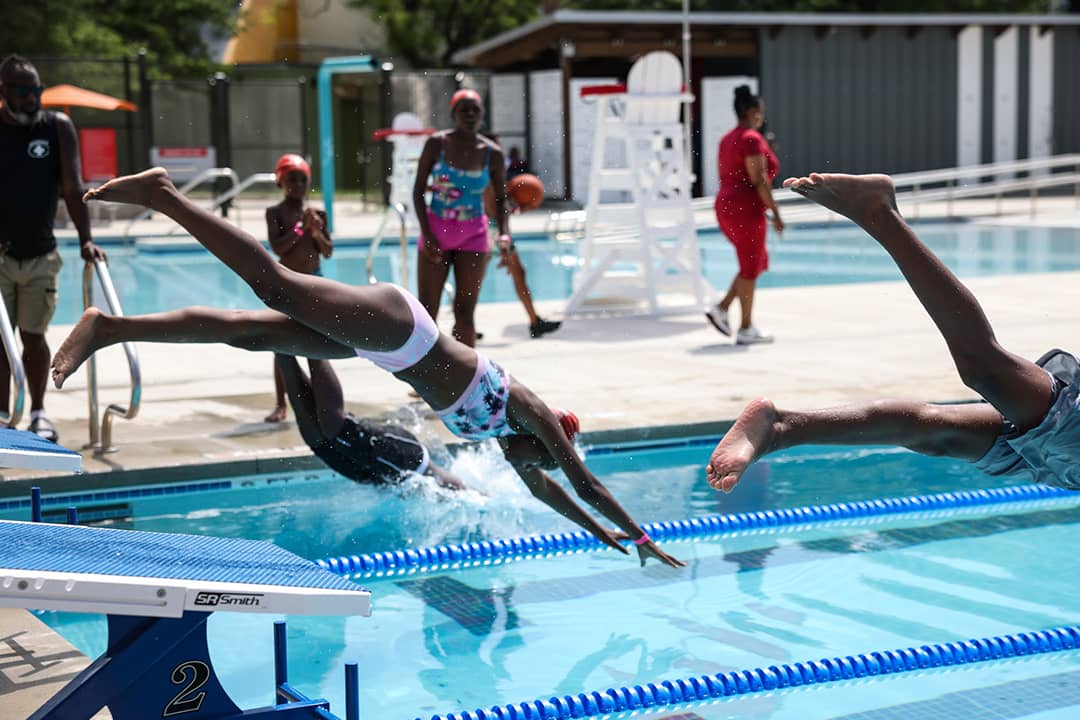
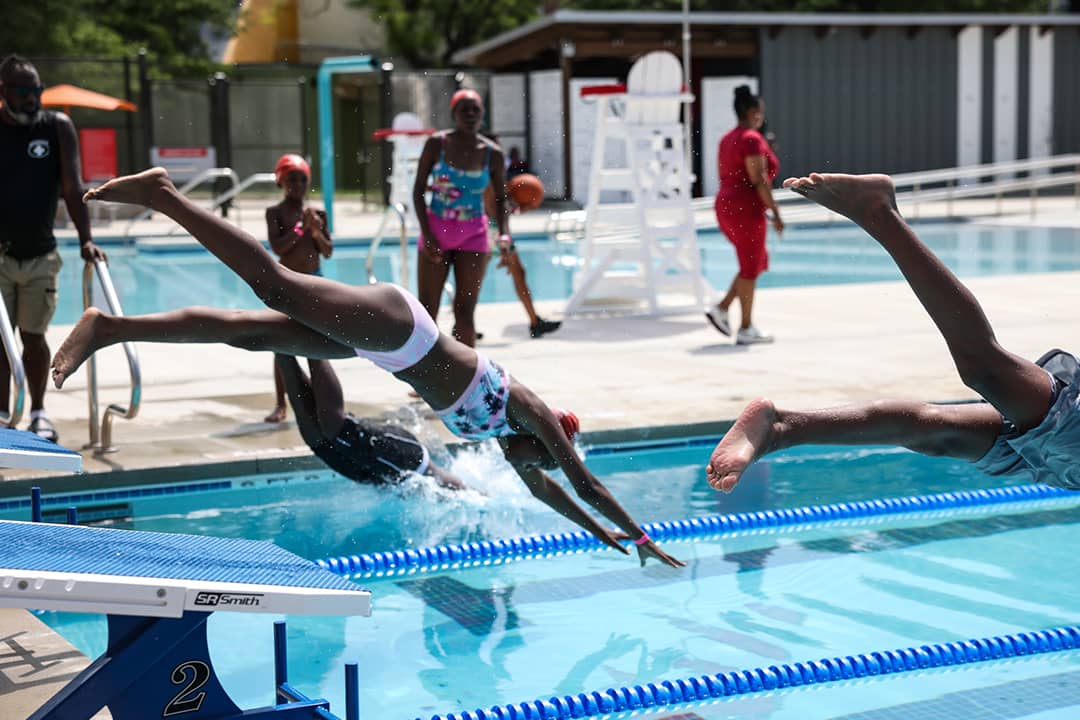
On one hot, humid Saturday earlier this month, children lined up at the Greater Model public pool in West Baltimore’s historically Black neighborhood of Poppleton. The youth adjusted their goggles and swim caps, then dove into the crisp water to meet their opponents on the other side.
The citywide swim meet — the first one organized by the Baltimore City Department of Recreation and Parks in a decade — was held at one of the city’s five newly renovated public pools. Next City examined how those renovations are part of a major effort by the city to close its long-standing gap in access to pools for Black residents.
For decades, Baltimore’s predominantly Black neighborhoods have received less than one-third as much investment as surrounding white communities. It’s a legacy that’s been driven by segregation, discriminatory lending, and unequal capital flow.
Pools — an affordable summer pastime for families, especially in an area where temperatures regularly exceed 90 degrees during the summer — are no exception. The aquatic amenities in West and East Baltimore are aging, unevenly maintained, and frequently closed. Most of the pools are more than 50 years old and have seen few if any upgrades in that time.
Recreation and Parks Director Reginald Moore Sr., who joined the city department in 2017, says the neglect cost the city more money over time than renovations would have.
“We had pools where the motors date back to the ‘80s,” Moore told Next City. “To get those pumps or motors, it was not like you [can] go to the nearest pool supply store and grab one off the shelf. I remember we had to pay one time for a motor to be overnighted from California, which was not cheap for our agency.”
Some families would take three buses in hopes of reaching a functioning pool, only to find out it was still closed, he says.
“If you don’t invest in assets, communities lose faith in the system, because they don’t know if it’s going to be open today,” Moore said. “The kids may go there for a couple days, then it’s broken, and they’re disappointed — they won’t want to go back.”
One pool patron told The Baltimore Banner that the old Towanda Pool in Park Heights would be closed some summers. The deep end was a meager 4 feet, he said, and residents were forced to bring their own lawn chairs to sit at the pool, surrounded by empty bottles and trash. Repair became more costly than replacement, and the city closed both the Towanda and Greater Model pools in 2019 for reconstruction.
Last year, the city opened the new Towanda Recreation Center — featuring an 8-foot-deep pool with starting blocks and lap lanes, a walk-in pool with sprinklers and waterspouts, a large partial shade covering, reclining chairs and umbrella-covered tables — as part of a $20 million investment in three neighborhood aquatic facility upgrades.
This year, the $8 million Greater Model Aquatic Center opened its doors just in time for the summer heat. The ribbon cutting for a fifth renovated aquatics facility, City Springs, is expected in about two years. Access to the pools is completely free.
Mayor Brandon Scott’s administration has funded the reconstruction effort through $41 million in federal COVID-19 pandemic relief money, part of the $641 million that Baltimore received under the American Rescue Plan Act. The city expects to tap into its own capital improvement program plus state funding to cover ongoing repairs and maintenance for the pools.
Undoing deep-rooted segregation
For decades, Baltimore’s Black residents were only permitted to use one of the city’s seven public pools.
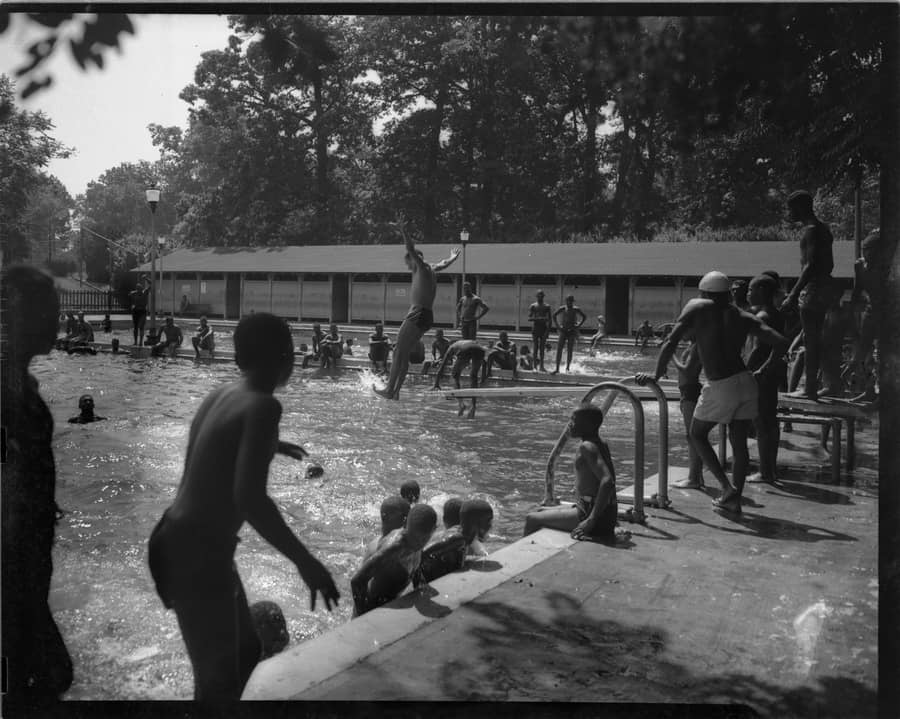
Paul S Henderson, Courtesy of the Maryland Center for History and Culture
Druid Hill Park pool “No. 2” opened in 1921, tucked beside the park’s maintenance yard. The pool was roughly half the size of the adjacent whites-only pool, and patrons said it was so overcrowded that swimmers had to be admitted in shifts. The other six pools were well-maintained, but closed to the nearby Black families.
The site now hosts a memorial for “No. 2” by artist Joyce J. Scott, depicting what it was like to swim in segregated America. She recounted that this pool’s water was filtered, while Pool No. 1’s was not, to “de-negroize” the city’s water supply.
In 1953, three Black children drowned in a single summer due to swimming in unsafe or restricted areas because of lack of access to city-operated pools. Following resident outcry and an NAACP lawsuit, the city in 1956 opened every public pool to all patrons, regardless of race.
The policy change did not bring equal access, however. De facto segregation continued in some Baltimore pools. And across the country, cities and suburbs responded to legal desegregation by draining pools, selling them to private neighborhood associations, or simply never building them. By 1971, the Supreme Court affirmed that a city could shutter a public facility rather than integrate it.
In Baltimore County, the parks department drafted a plan in 1953 for public pools at elementary schools, then abandoned it. By 1966, some 150 private swim clubs were operating there instead — some bound by covenants barring Black and Jewish members. To this day, the county has no public pools.
Inside the city line, the pools stayed public but stopped being maintained. Decades of disinvestment in the same redlined neighborhoods — the “Black Butterfly” of East and West Baltimore — left their aquatic facilities running on mid-century mechanical systems.
“Honestly, the ugly, dark history is something that no one wants to continue to relive,” said Moore, of the recreation and parks department. “For me, it’s motivation that we focus on how we address the needs of our communities.”
Today, Baltimore has 22 public pools. The city hired architecture and design firm CannonDesign to focus on five pools in the worst condition. CannonDesign says the city’s facility condition assessment found every single neighborhood pool had reached the end of its lifespan, but the firm isn’t currently contracted to update the other 17 pools.
“They all need to be replaced or have extensive work done, so we said, ‘Okay, we need to design a system that can potentially be adapted and reused all over the city,’” explained CannonDesign design leader Monica Pascatore. Her team designed the five aquatic facilities around a “kit of parts” — a bathhouse, a pump house, two bodies of water and a security fence — meant to be affordable and adaptable enough to drop onto remaining sites.
When the City Springs site’s original blueprint showed that the facilities wouldn’t accommodate the same two-pool layout as the others, the team adjusted its designs until it could deliver that second pool.
“If you flip the site, we can actually build both pools,” Pascatore said. “If one neighborhood has two pools, every neighborhood should get two pools. Nobody gets shortchanged.”
Investing in Black safety and joy
Vacshon Brown is the manager of the newly renovated Greater Model pool. His earliest memory of being in a public pool was with his swim instructor, Miss Judy. He was nervous, like any kid staring at a 5-foot-deep pool without knowing how to swim. But he remembers how soft and gentle and reassuring she was with him.
“I’ll never forget Miss Judy,” Brown said. “Without the pool, I probably would have never met Miss Judy. That’s someone I can call a friend.”
He tries to pass that same level of comfort on to the kids he instructs now, because he remembers how it felt to have to jump when he was most afraid.
Were the pool to close again, it would hurt local youth, he says.
“The neighborhood would lose a safe haven,” Brown said. “Especially the kids. I know a lot of them by first name.”
Greater Model was his father’s childhood pool, and Brown remembers his dad’s face when he heard it was coming back. “He was even more excited when he saw the rebuilt version,” Brown said. “We got two amazing bodies of water. We got chairs and tables on our deck. I’ve never seen anything like it as far as community pools in the city.”
The Greater Model pool now averages about 150 visitors a day; the old pool design saw only up to 60 patrons. The recent renovations have resulted in a record-breaking first five weeks of the 2026 season for the parks department, with 200,000 visitors citywide. Moore and Pascatore say that attendance doubled compared to the same period in 2025 during a multiday extreme-heat stretch.
Those numbers are exciting local leaders who hope the increased access will increase public health and safety for Black Baltimoreans, too.
The Centers for Disease Control and Prevention declared drowning the leading cause of accidental death in children ages 1 to 14 years old. A recent CDC report on drowning disparities notes that in swimming pools, Black children ages 10-14 years drown at rates 7.6 times higher than white children. Black young adults, too, drown at 1.5 times the rate of their white counterparts.
An estimated 64% of Black children have little to no swimming skills, as compared to 40% of white children. In households under $50,000, some 79% of children cannot swim.
Moore says the parks department is actively combatting these statistics, including through its elimination of access fees in 2020 and its investment in learn-to-swim, swim meet, and lifeguard programs, including peer-to-peer training and a skills competition. To further aquatics accessibility, the department is offering free lifeguard training and certification directly to swim team members at the age of 15.
But upgrades had to come first, he says.
“How are we going to teach them if I have one body of water, and it goes from 3 feet to 6 feet deep?” Moore asked. “Can you imagine if you’re in the middle of the training and the system goes down? I didn’t want to implement other strategies until we had facilities that were not going to be an operational issue.”
With the new swim meets and Lifeguard Club, Moore said Baltimore’s kids are receiving a stronger sense of community and camaraderie.
“That’s what warms my heart,” Moore said. “They’re coming from predominantly Black communities, and these opportunities were not previously afforded to them. It’s not always about the competition — it’s all about networking and connections, and growing our young people to have relationships outside their neighborhoods, around their community.”
This story was produced by Next City, a nonprofit newsroom covering solutions for equitable cities, and reviewed and distributed by Stacker.