Vadzo Imaging Positions Falcon-3C10CRS: 3MP Color HDR USB Camera with Omnivision OX3C10 Sensor for Outdoot Robotics and HDR Applications
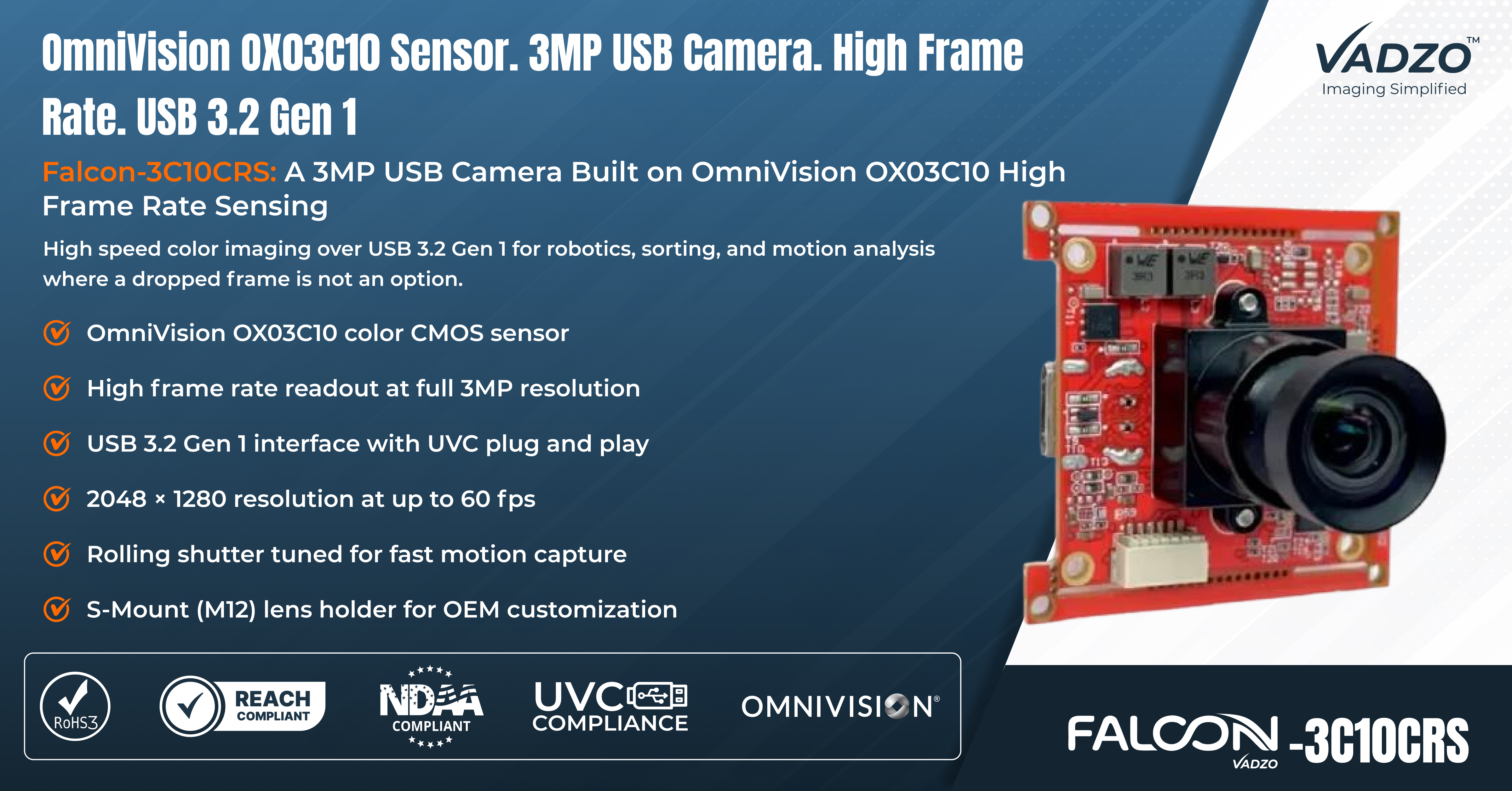
Built for applications where motion cannot be allowed to blur or drop a frame, this compact USB camera pairs the

Press Release Disclaimer: This is a press release distributed through the XPR Media network. It has not been independently verified by our newsroom.


Built for applications where motion cannot be allowed to blur or drop a frame, this compact USB camera pairs the OmniVision OX03C10 color sensor with high frame rate readout and USB 3.2 Gen 1 connectivity, giving integrators dependable high-speed color capture for robotics, sorting, and motion analysis without a proprietary interface or a networked connection.
FORT WORTH, TX / ACCESS Newswire / August 13, 2026 / Vadzo Imaging, a provider of embedded vision solutions, today launched the Falcon-3C10CRS, a 3MP USB Camera built around the OmniVision OX03C10 color sensor for high-speed motion capture, robotics, and industrial sorting applications that cannot tolerate blur or dropped frames.
Why Fast Motion Applications Need a 3MP HDR USB Camera Built for High Frame Rate Capture
Robotics work cells, sorting lines, and motion analysis systems all share one requirement that ordinary security or inspection camera products were never designed to meet: capturing a moving object clearly enough, and often enough, that no meaningful motion happens between one frame and the next. A camera running at a modest frame rate leaves gaps large enough for a fast-moving part, ball, or package to travel several centimeters or more before the next frame is captured, which is exactly the blind spot that causes a tracking algorithm to lose a target or a sorting system to misclassify an item.
A High Frame Rate USB Camera also has to solve a resolution balance that many systems get wrong. Pushing frame rate up by cropping resolution or dropping color depth can leave too little detail for a barcode read or a color-based sort decision, while holding onto full 3MP resolution at a slow frame rate reintroduces the motion blur problem from the other direction. Getting both resolution and frame rate at once typically exceeds USB 2.0 bandwidth, which is where a USB 3.2 Gen 1 interface actually pays for itself.
Engineering Explanation: Speed, Resolution, and Color Without Compromise
OmniVision built the OX03C10 primarily for automotive and industrial imaging roles that demand dependable timing alongside strong image quality, and that same sensor architecture happens to deliver the frame rate headroom that motion-sensitive applications need. As an OX03C10 High Frame Rate Camera, the sensor reads out its full pixel array fast enough to keep pace with objects moving through a robotic work cell or a sorting line far quicker than a standard security sensor could follow.
The sensor’s rolling shutter reads pixel rows sequentially rather than capturing the entire frame at once, which is a meaningful engineering balance worth understanding. As an OX03C10 Rolling Shutter Camera, it favors fast row readout over the more complex pixel design a global shutter would require, and for most horizontal or vertical motion at typical work cell speeds, that keeps skew to a level machine vision software can compensate for computationally. The 3MP Rolling Shutter Camera configuration in the Falcon-3C10CRS is tuned for exactly that balance between readout speed and image geometry.
Color reproduction adds a second engineering dimension that a monochrome high-speed sensor cannot match. As a High Speed Color Camera, the OX03C10 preserves full color information at speed, which matters directly for sorting systems making decisions based on product color, packaging color, or status indicator color rather than shape alone.
Product Overview
The Falcon-3C10CRS pairs the OX03C10 3MP Camera sensor with a USB 3.2 Gen 1 interface and an S-Mount (M12) lens holder in a compact board-level design suited to both direct integration and enclosed camera deployment. As a 3MP USB Camera, it outputs 2048 × 1280 resolution at up to 60 frames per second with full color reproduction, and built specifically as a 3MP Color USB Camera, it gives integrators a single platform covering high-speed motion capture, color-based sorting, and general purpose machine vision from one module.
At the core of the module sits the OmniVision OX03C10 Color Camera sensor, a color CMOS device with a 3.0 micron pixel and rolling shutter readout tuned for high frame rate performance rather than daylight image quality alone. Because the sensor was engineered as a 3MP Color Sensor Module with speed as a primary design goal, the Falcon-3C10CRS reaches frame rates that most standard 3MP HDR sensors cannot sustain at full resolution, which matters directly for any application where a missed frame means a missed detection.
Key Capabilities
Embedded Fault Reporting via ASIL C Diagnostic Pins for Detectable Sensor Health: A camera that fails without signaling the failure is a liability in any system replacing a mechanical safety component like a mirror. The OX03C10 in the Falcon-3C10CRS carries embedded temperature and supply voltage monitoring alongside dedicated ERRB and VM_ERRB error-reporting outputs, giving OEM teams a discrete signal path to detect degraded sensor conditions rather than inferring failure from image quality alone. For OX03C10 usb camera integrations in off-highway CMS or other safety-adjacent vision systems, this turns sensor health into a signal the host system can act on directly.
Simultaneous HDR and LED Flicker Mitigation via the HALE Combination Engine: Sensors that handle high dynamic range and LED flicker mitigation as separate processing modes typically force a choice between the two under difficult lighting, since running both simultaneously usually exceeds the sensor’s processing budget. OmniVision’s HALE engine in the OX03C10 combines HDR and LFM processing concurrently, so the Falcon-3C10CRS holds both wide dynamic range and flicker-free capture in the same frame rather than switching between modes as lighting conditions shift.
Stacked-Die PureCel®Plus-S Architecture for a 20% SNR Improvement Over Prior-Generation Sensors: Viewing-camera sensors built on non-stacked architectures reach a pixel and dark-current performance ceiling that limits low-light signal quality regardless of pixel size. The OX03C10’s PureCel®Plus-S stacked-die construction lifts pixel and dark-current performance 20% in signal-to-noise ratio over OmniVision’s prior 2.5MP viewing sensor generation, giving the Falcon-3C10CRS cleaner signal in the same low-light conditions a non-stacked sensor of equivalent pixel size would struggle with.
External Frame Synchronization for Multi-Camera Stitching and Correlated Capture: Multi-camera CMS and surround-view configurations that stitch or correlate feeds from several cameras need frame capture aligned across units – a misaligned frame from even one camera in the array introduces stitching artifacts or timing mismatch downstream. The OX03C10’s external frame synchronization (FSIN) capability lets multiple Falcon-3C10CRS units be triggered to a shared timing reference, giving integrators frame-aligned capture across a multi-camera array without relying on host-side software synchronization.
Motion-Optimized 3-Capture HDR Alongside Full 4-Capture HDR for Latency-Sensitive Modes: Not every deployment can tolerate the additional capture latency of full 4-exposure HDR combination. The OX03C10 offers a motion-free 3-capture HDR mode using Deep Well dual conversion gain (DCG) technology specifically optimized to minimize motion artifacts, alongside the full split-pixel 4-capture mode for maximum dynamic range. This gives OEM teams building the Falcon-3C10CRS into a moving-platform application a latency-versus-dynamic-range tradeoff they can select rather than one fixed HDR pipeline.
Full 1920×1280 Resolution at 60fps for Fast Multi-View Switching: CMS and multi-camera dashboard systems that switch between camera feeds need the destination feed at full resolution immediately, not after a ramp-up period. The OX03C10 sustains its full 1920×1280 resolution at up to 60fps, the highest rate available in a 2.5MP HDR-and-LFM viewing sensor at the time of its release, giving the Falcon-3C10CRS fast view-switching response for driver- or operator-facing multi-camera displays.
Application
Outdoor Mobile Robotics and Field Navigation: Autonomous mobile robots and outdoor field robots operating across open terrain encounter lighting swings a controlled indoor environment never presents – direct sun on one side of a path, deep shadow from tree cover or structures on the other, all within a single frame the navigation stack has to interpret in real time. The Falcon-3C10CRS’s 140dB HDR keeps both bright and shadowed regions of the scene usable for obstacle detection and path-planning algorithms, without the ghosting risk that multi-frame HDR introduces on a moving platform. As an OX03C10 HDR USB Camera, it gives outdoor robotics integrators a single sensor that holds up across a full day’s lighting conditions rather than requiring exposure retuning between environments.
Agricultural and Precision Farming Robotics: Field robots performing crop scouting, precision spraying, or autonomous harvesting operate under some of the least controllable lighting conditions in outdoor robotics – direct overhead sun, canopy-filtered shade, and reflective wet foliage often appear in the same pass. The Falcon-3C10CRS’s motion-optimized 3-capture HDR mode, using Deep Well dual conversion gain technology, keeps this variation from producing motion artifacts as the robot moves through the field, giving vision-guided agricultural systems a cleaner input than a fixed-exposure sensor would deliver.
Outdoor Delivery and Last-Mile Robotics: Sidewalk and last-mile delivery robots need consistent perception across a route that shifts between open sky, building shadow, and artificial lighting as the day progresses. The Falcon-3C10CRS’s HALE engine, combining HDR and LED flicker mitigation simultaneously, keeps footage usable both under direct sunlight and near flicker-prone LED signage or streetlighting encountered along a delivery route, without forcing a tradeoff between the two correction modes.
HDR Inspection and Monitoring in Industrial Outdoor Robotics: Robotic inspection platforms working outdoor industrial sites need to resolve detail in both glare-heavy reflective surfaces and shadowed structural areas within the same inspection pass. The Falcon-3C10CRS’s full 4-capture 140dB HDR mode extends usable dynamic range across this contrast spread, giving outdoor inspection robotics a wider working range before highlight clipping or shadow loss becomes a data quality issue.
Wide-Temperature Outdoor Robotics Deployment: Robots operating outdoors across seasonal extremes, such as agricultural equipment through winter and summer, delivery robots in variable climates, need imaging hardware rated for the full range rather than a separate SKU per climate zone. The Falcon-3C10CRS’s -40°C to +105°C sensor ambient rating covers this range within a single camera, removing hardware fragmentation across a multi-region robotics deployment.
Frequently Asked Questions
Q: What makes the OX03C10 an ASIL C sensor, and why does that matter for a USB camera?
A: ASIL C refers to an automotive functional safety classification requiring the sensor to support fault detection and reporting, not just image capture. The OX03C10 meets this through embedded temperature and supply voltage monitoring and dedicated ERRB/VM_ERRB error-reporting pins, giving a host system a way to detect a degraded or failed sensor condition directly rather than inferring it from image quality. This matters for any USB camera application, like a camera monitor system, standing in for a safety-relevant function where undetected failure has real consequences.
Q: Can the Falcon-3C10CRS handle both high dynamic range and LED flicker mitigation in the same frame?
A: Yes. The OX03C10’s HALE engine combines HDR and LED flicker mitigation processing simultaneously rather than requiring a tradeoff between the two, so the Falcon-3C10CRS maintains both wide dynamic range and flicker-free capture under the same lighting conditions.
Q: How does the OX03C10’s stacked-die construction improve image quality over a non-stacked sensor?
A: The OX03C10 is built on OmniVision’s PureCel®Plus-S stacked-die architecture, which improves pixel and dark-current performance and delivers a 20% signal-to-noise ratio improvement over OmniVision’s prior-generation 2.5MP viewing sensors, giving cleaner low-light signal than a non-stacked sensor of equivalent pixel size.
Q: Can multiple Falcon-3C10CRS units be synchronized for a surround-view or multi-camera system?
A: Yes. The OX03C10 supports external frame synchronization (FSIN), letting multiple Falcon-3C10CRS units be triggered to a shared timing reference for frame-aligned capture across a multi-camera array, which is required for stitched surround-view output.
Q: What operating temperature range does the Falcon-3C10CRS support?
A: The OX03C10 sensor is rated for -40°C to +105°C ambient operating temperature (with junction temperature rated to +125°C), covering marine, cold-storage, and wide-seasonal-swing industrial deployments within a single camera SKU.
Availability
The Falcon-3C10CRS 3MP HDR USB Camera is available now for evaluation and OEM integration. Evaluation kits include the camera module, a factory-calibrated S-Mount lens, a USB 3.2 Gen 1 cable, and integration documentation covering UVC setup and Vispa ARC SDK configuration, with no minimum order requirement. Contact Vadzo Imaging at support@vadzoimaging.com to request an evaluation unit or discuss volume production and OEM customization.
About Vadzo Imaging
Vadzo Imaging develops embedded and machine vision camera products for OEMs and system integrators building production-ready vision systems across robotics, industrial automation, logistics, and edge AI. The company’s portfolio spans MIPI CSI-2, USB, GigE, Wi-Fi, and SerDes interface camera products, supporting deployment architectures from compact onboard modules to distributed networked installations. Vadzo provides end-to-end imaging support including sensor integration, ISP tuning, firmware development, and SDK frameworks to accelerate system deployment. Visit Vadzo Imaging to explore the full embedded vision camera portfolio.
Media Contact
Alwin Vincent
Vadzo Imaging
Email: alwin@vadzoimaging.com
LinkedIn: Vadzo Imaging
YouTube: Vadzo Imaging
X: Vadzo Imaging
SOURCE: Vadzo Imaging
View the original press release on ACCESS Newswire
Media gallery