
New Preprint Finds Lithium Ascorbate Outperforms Prescription Lithium with Fewer Side Effects
In preclinical studies, this lithium-vitamin C compound showed anti-anxiety and antidepressant-like effects across 4

Press Release Disclaimer: This is a press release distributed through the XPR Media network. It has not been independently verified by our newsroom.

In preclinical studies, this lithium-vitamin C compound showed anti-anxiety and antidepressant-like effects across 4 stress models without weight gain.
NEW YORK, NY, UNITED STATES, August 10, 2026 /EINPresswire.com/ — A new research preprint published on Research Square highlights lithium ascorbate as a potential alternative to conventional lithium carbonate, which is limited by a narrow therapeutic window and concerns about organ-related adverse effects. In preclinical studies, this organic compound combining lithium with vitamin C demonstrated anti-anxiety and antidepressant-like effects across four behavioral stress models, outperforming standard comparator treatments without causing significant weight gain.
Researchers tested lithium salts’ effects on rodent behavior. The substances tested in the study were:
– Lithium carbonate.
– Lithium orotate.
– Lithium succinate.
– Lithium ascorbate.
– Ascorbic acid.
Lithium carbonate is an inorganic lithium salt that is traditionally used as a prescription medication for bipolar disorder and treatment-resistant depression. However, it has a narrow dosage window where lithium carbonate stays effective and doesn’t cause damage to the body.
Professor Olga Gromova, M.D., a clinical pharmacologist and the chief scientific officer for Normotim, said: “Lithium carbonate is inorganic. It is easy and inexpensive to produce, so it is widely used in psychiatry. The body does not fully absorb lithium carbonate, so doctors prescribe higher doses compared to other lithium forms. The more lithium carbonate is present in the body, the more lithium the kidneys must process and excrete through urine.”
Organic lithium salts such as lithium orotate and lithium ascorbate are being researched as potential alternatives to lithium carbonate. It appears that organic lithium salts are better absorbed and tolerated than inorganic forms.
Dr. Gromova said: “Organic lithium salts such as lithium ascorbate, lithium citrate, and lithium orotate interact more smoothly with biological systems. The molecules bound to lithium in organic salts participate in metabolic pathways, unlike those in inorganic salts.”
Lithium ascorbate is a compound of lithium and ascorbic acid (Vitamin C), which possesses distinct properties unlike carbonate or orotate. Ascorbic acid partakes in immune function, collagen production, and cellular metabolism.
Experiments Conducted
Open field test: Measures locomotion, exploration, and anxiety by recording how an animal navigates a novel open arena.
Swimming test: Measures depression-like behavioral despair by timing how long a rodent struggles versus floats in inescapable water.
Tail suspension test: Evaluates depression-like behavior by measuring active escape attempts versus passive immobility while a rodent is hung by its tail.
Simulated transport stress test: Models relocation stress by exposing animals to controlled motion, vibration, and noise in a lab environment.
Across all tests, lithium ascorbate showed the best results as a potential anti-anxiety and antidepressant substance.
Lithium ascorbate reduced immobility, increased active or sustained coping, and enhanced locomotor and exploratory activity. It also increased center entries, reduced grooming and defecation, and lowered post-stress adrenaline and norepinephrine.
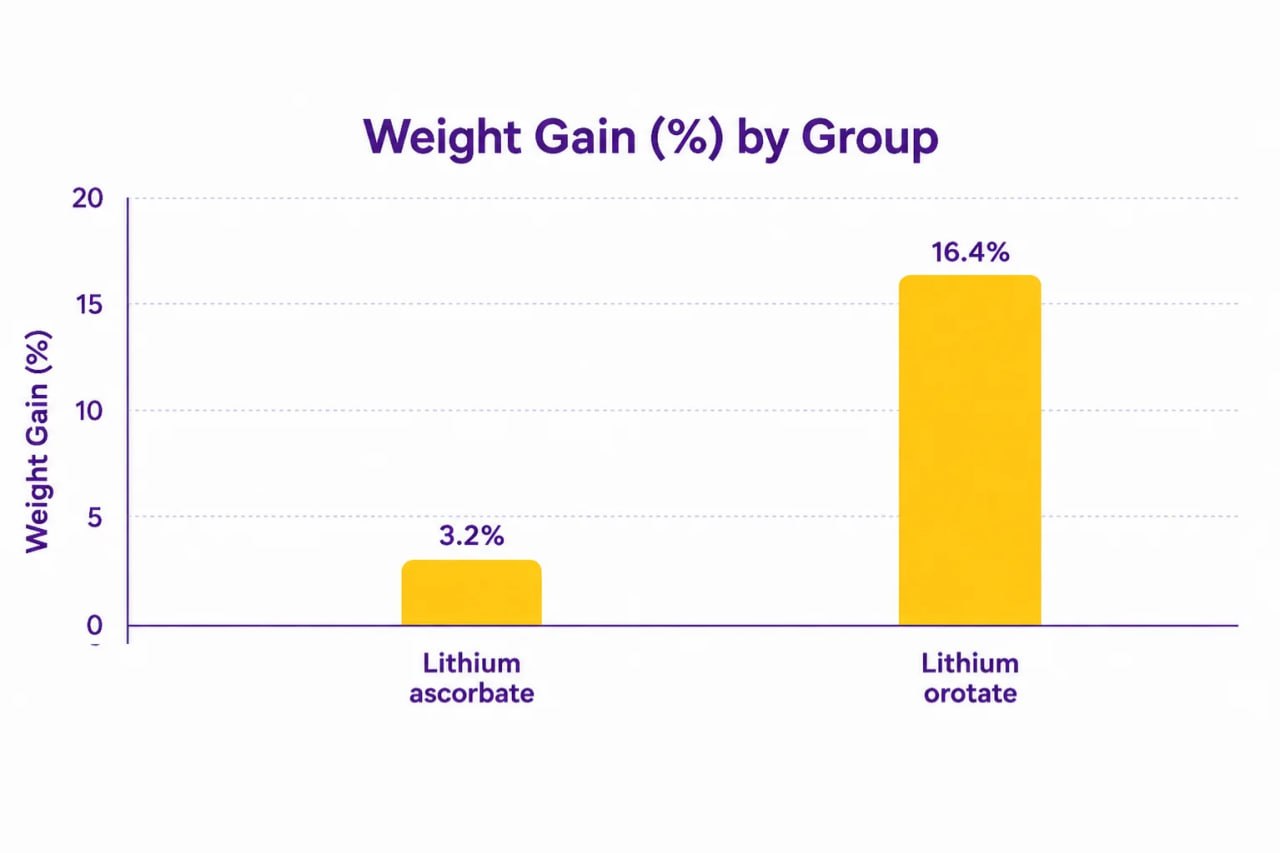
Lithium ascorbate and lithium orotate went head-to-head in the open field test with one big downside for orotate – weight gain. Animals on lithium orotate gained 16.4% in body weight compared to the control group, while lithium ascorbate stayed at 3.2%
Limitations of the study
Limitations include small samples, unequal elemental lithium exposure, differences in species, dosing and administration, repeated-testing effects, indirect stress markers, and the inability of rodent models to establish clinical efficacy in humans.
Vlada Sukhanovskaya
Normopharm
email us here
+1 917-361-1677
Visit us on social media:
LinkedIn
Legal Disclaimer:
EIN Presswire provides this news content “as is” without warranty of any kind. We do not accept any responsibility or liability
for the accuracy, content, images, videos, licenses, completeness, legality, or reliability of the information contained in this
article. If you have any complaints or copyright issues related to this article, kindly contact the author above.

Media gallery


