How light and AI could make laser welding self-correcting
GA, UNITED STATES, July 30, 2026 /EINPresswire.com/ -- A research team has mapped the rapidly expanding toolkit for

Press Release Disclaimer: This is a press release distributed through the XPR Media network. It has not been independently verified by our newsroom.
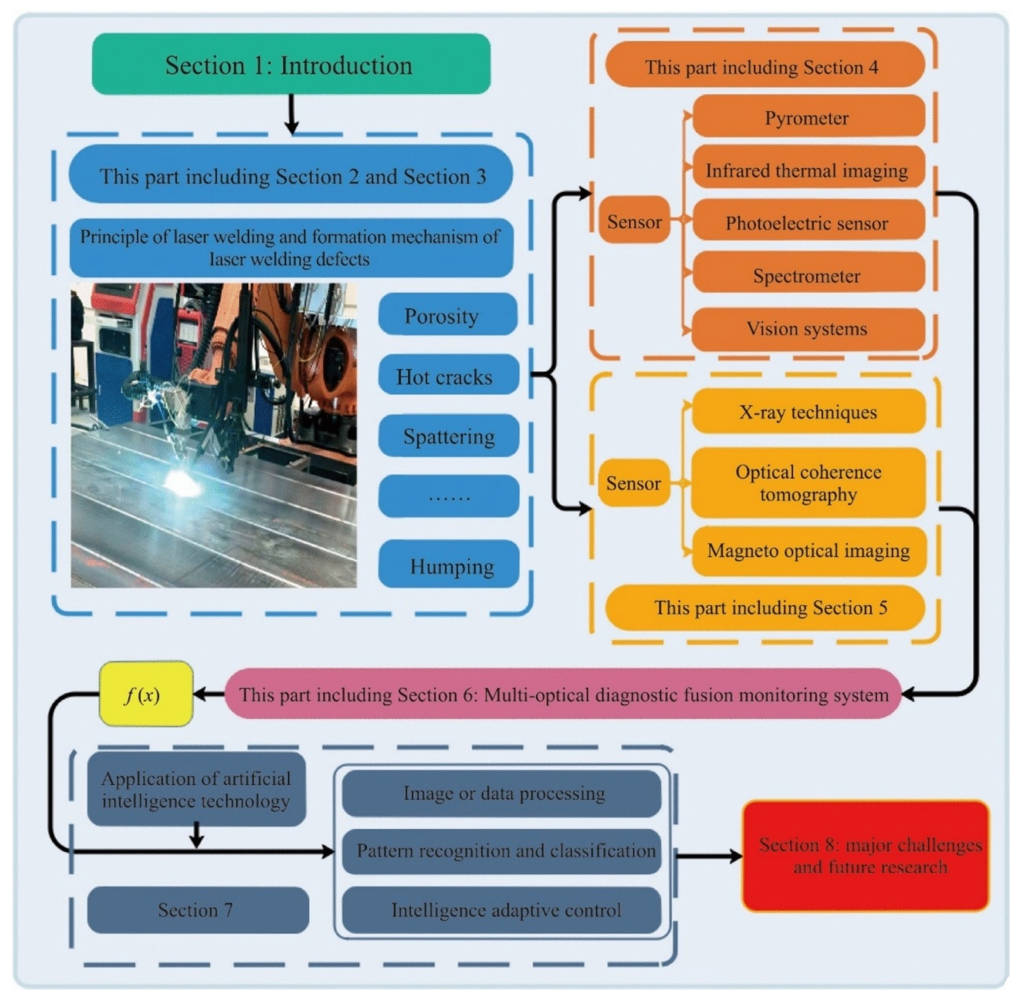

GA, UNITED STATES, July 30, 2026 /EINPresswire.com/ — A research team has mapped the rapidly expanding toolkit for watching laser welds as they form, showing how optical sensors and artificial intelligence (AI) can reveal defects before a finished component leaves the production line. The review connects the physics of molten pools, keyholes, plasma plumes and spatter with the signals captured by cameras, photodiodes, spectrometers and other optical systems. It also examines how AI can process these signals, classify weld quality and guide adaptive control. By bringing sensing, defect recognition and process adjustment into one framework, the work outlines a path toward faster, more consistent and less wasteful laser welding in precision manufacturing.
Laser welding joins materials with a concentrated, high-energy beam and is valued for its speed, narrow heat-affected zone and ability to produce deep, precise welds. Yet the process unfolds in milliseconds and can be disrupted by unstable keyholes, molten-metal flow, plasma shielding or spatter, leading to porosity, cracking, underfill, humps and incomplete fusion. Conventional inspection often takes place after welding, when defective parts are costly to repair or discard. Acoustic monitoring can also be weakened by factory noise and mechanical vibration, while a single optical sensor may capture only part of the process. Because of these challenges, in-depth research is needed into optical monitoring systems that can interpret fast-changing weld behavior and support immediate correction.
Researchers from the Guangdong Provincial Welding Engineering Technology Research Center at Guangdong University of Technology published (DOI: 10.1007/s40436-024-00493-1) the review online on June 3, 2024, in Advances in Manufacturing. The team analyzed recent progress in real-time laser welding monitoring across laboratory and industrial settings, organizing the field around defect-formation mechanisms, optical sensing strategies, multisensor fusion and artificial intelligence (AI)-assisted decision-making. Their assessment compares the strengths and limits of radiation-based and externally illuminated diagnostic systems, then examines how machine learning and deep learning are being used for signal processing, defect prediction, classification and closed-loop control.
The review first links common defects to the rapidly changing physics inside the weld. Unstable keyholes can trap pores; thermal contraction and alloy behavior can promote cracking; excessive energy or melt flow can produce underfill, spatter or surface humps. It then divides optical monitoring into two broad families. Radiation-based systems read light naturally emitted or reflected during welding. Pyrometers and infrared cameras track temperature and cooling; photodiodes measure rapid intensity changes; spectrometers analyze plasma emissions; and vision systems follow the geometry of the molten pool, keyhole and plume. Active-light systems add an external source. X-ray imaging exposes internal flow and pore formation, while optical coherence tomography (OCT), also used as inline coherent imaging (ICI), measures weld depth with micrometer-scale resolution. Magneto-optical imaging can assist seam tracking in extremely narrow joints. The review compares cost, sampling speed, spatial resolution and suitability for real-time factory use across these approaches. Because every method has blind spots, the authors emphasize multisensor fusion. AI models—including support vector machines (SVMs) and convolutional neural networks (CNNs)—can combine images and signals, extract features, classify penetration states and feed information to controllers that adjust laser power, speed, focus or wire feed during welding.
The authors said the central lesson is that no single sensor can tell the whole story of a laser weld. Temperature, light intensity, plasma spectra and keyhole geometry each describe a different part of the same fast-moving event, they said, and the most reliable systems will combine these views rather than depend on one signal. They added that AI is most valuable when it turns those measurements into timely, understandable decisions—not simply when it produces a classification score. Future systems must therefore be accurate, interpretable and fast enough to act before a defect becomes permanent.
The framework could accelerate quality control in automotive, aerospace, shipbuilding, bridge construction and additive manufacturing, where a hidden pore or incomplete joint can compromise performance and raise costs. Real-time monitoring may reduce destructive testing, rework, scrap and downtime while improving traceability across automated production lines. The review also identifies barriers to industrial deployment: high-dimensional data, inconsistent sampling rates, limited labeled datasets, costly equipment and AI models that are difficult to interpret outside their training conditions. Progress will depend on standardized datasets, robust multisensor architectures and closer integration of physics-based knowledge with data-driven learning. These advances could ultimately move laser welding from passive inspection toward self-monitoring, self-adjusting manufacturing.
References
DOI
10.1007/s40436-024-00493-1
Original Source URL
https://doi.org/10.1007/s40436-024-00493-1
Funding information
The National Natural Science Foundation of China (Grant No. 52275317), the Guangdong Provincial Natural Science Foundation of China (Grant No. 2023A1515012172), and the Guangzhou Municipal Special Fund Project for Scientific and Technological Innovation and Development (Grant No. 2023B03J1326) provided financial support for this work.
Lucy Wang
BioDesign Research
email us here
Legal Disclaimer:
EIN Presswire provides this news content “as is” without warranty of any kind. We do not accept any responsibility or liability
for the accuracy, content, images, videos, licenses, completeness, legality, or reliability of the information contained in this
article. If you have any complaints or copyright issues related to this article, kindly contact the author above.

Media gallery